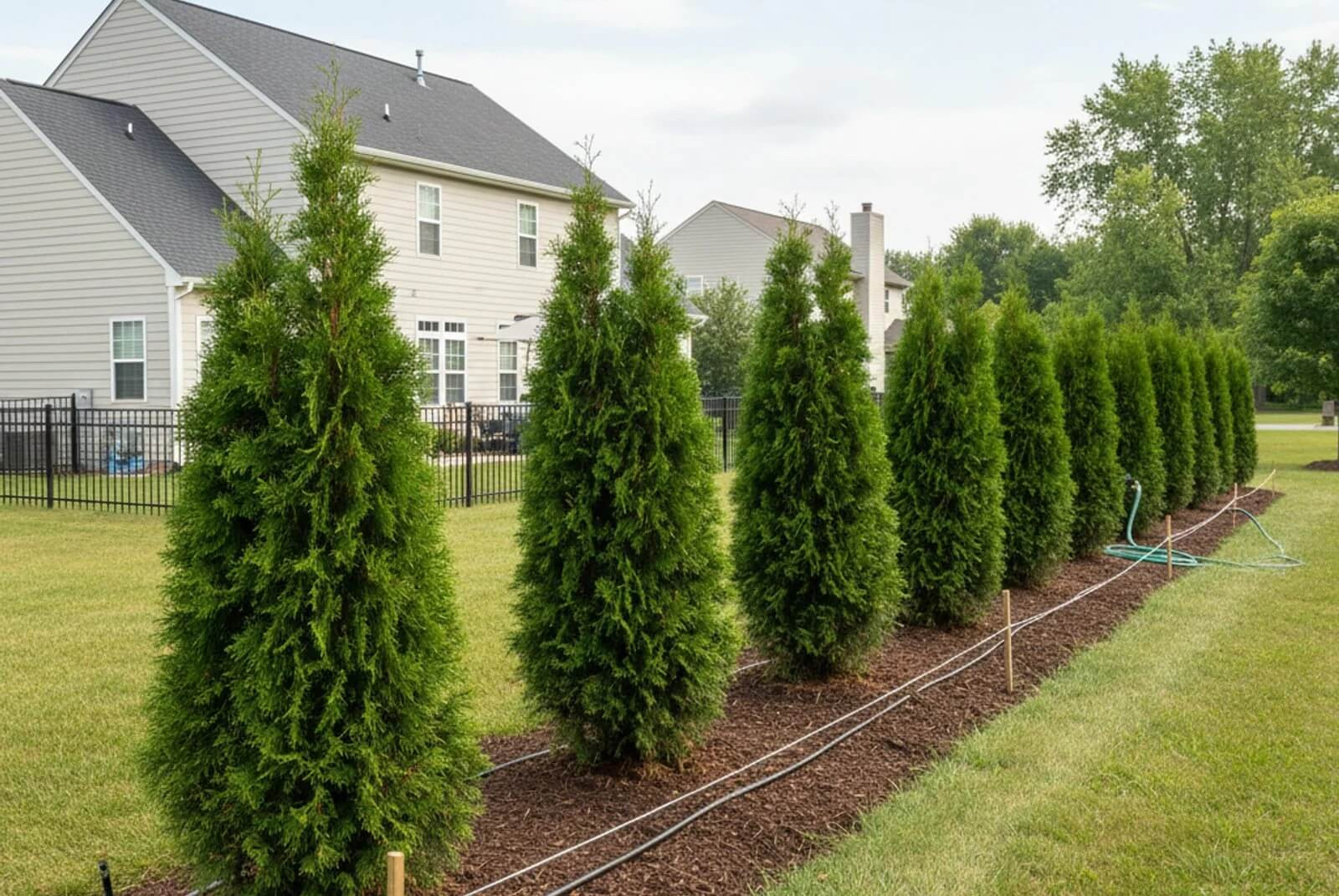
A well-planned row of trees can do more than block a neighbor’s view. It can soften a fence, screen an exposed patio, reduce unwanted views from nearby windows, and make a garden feel more secluded.
The challenge is choosing trees that grow quickly enough to provide privacy without eventually overwhelming the space.
Evergreen trees are especially useful because they retain their foliage year-round. However, growth rate alone should not determine your choice.
A tree that adds several feet of height annually may also develop an enormous root system, spread too widely, or require more maintenance than you anticipated.
Before planting, consider your USDA hardiness zone, soil drainage, available sunlight, and the tree’s mature height and width. Also, think about the view you need to block. A narrow screen along a boundary calls for different trees than a tall screen protecting a two-storey house.
Here are 15 trees worth considering, ranging from fast-growing evergreens to slower, narrower options for specific spaces.
15 Best Fast-Growing Trees for Privacy
1. Cryptomeria japonica ‘Radicans’ (Japanese Cedar)
Japanese cedar is an attractive evergreen conifer with soft, feathery foliage and a naturally pyramidal shape. The ‘Radicans’ cultivar is valued for its relatively fast growth, typically adding around 2 to 3 feet a year under favorable conditions.
It can reach approximately 30 to 40 feet tall and 15 to 20 feet wide, making it suitable for screening larger gardens. Its blue-green foliage generally retains its color through winter, with less bronzing than some other Japanese cedar varieties.
For the best results, grow ‘Radicans’ in USDA hardiness zones 5 to 9. It prefers full sun, although light shade is tolerated, and moist, fertile, slightly acidic soil that drains well. Young trees are particularly vulnerable to root rot, so avoid waterlogged planting sites.
If you like the appearance of Japanese cedar but have limited space, look into dwarf cultivars. These offer a similar foliage texture without requiring the room of a full-sized screening tree.
2. Leyland Cypress (× Cuprocyparis leylandii)
Leyland cypress is one of the best-known choices for creating a tall, dense privacy screen in a relatively short time. Its fine, evergreen foliage and rapid growth make it particularly appealing when a fence or young hedge offers little immediate protection from neighboring properties.
Under suitable conditions, an untrimmed tree can reach around 40 to 60 feet tall, with a spread of approximately 15 to 20 feet. It generally performs best in USDA zones 6 to 10 and grows in full sun or partial shade.
Plant Leyland cypress in well-drained soil and water it consistently while it establishes. Although the tree grows quickly, that advantage can become a disadvantage when it is planted too close to buildings, boundaries, or other trees. Overcrowding and unsuitable growing conditions can also increase pest and disease problems.
Choose this tree when you have room for a substantial screen and are prepared to manage its size. For a small garden, a more compact evergreen will usually be easier to maintain.
3. Lawson Cypress ‘Ellwoodii’ (Chamaecyparis lawsoniana ‘Ellwoodii’)
If you prefer a neat, formal screen rather than a towering wall of greenery, Lawson cypress ‘Ellwoodii’ is worth considering. This evergreen has a compact, upright growth habit and attractive foliage that gives it a refined appearance in smaller landscapes.
It is slower-growing than Leyland cypress, generally reaching around 13 to 20 feet tall and 5 to 8 feet wide, depending on conditions. Consequently, it is not the strongest choice when your main priority is obtaining the fastest possible coverage.
Grow it in USDA zones 5 to 8, in full sun or partial shade. Moist, well-drained, slightly acidic soil suits it best. Once established in an appropriate location, it requires relatively little pruning to maintain its natural shape.
The key is to buy the right cultivar for your intended screen. Lawson cypress includes varieties with substantially different mature sizes, so check the plant label rather than assuming every variety will grow into a tall, narrow tree.
4. Emerald Green Arborvitae (Thuja occidentalis ‘Smaragd’)
Emerald Green arborvitae is a useful option when you want a dense evergreen screen without sacrificing too much garden space. Its upright, naturally conical form creates a tidy row, while its rich green foliage generally retains its color through winter.
Mature trees commonly reach about 12 to 14 feet tall and 3 to 4 feet wide. This relatively narrow profile makes them easier to fit along property boundaries than broad screening trees.
Emerald Green arborvitae performs well in USDA zones 3 to 8. It grows in full sun or partial shade and prefers moist, well-drained soil. Good sunlight helps maintain dense growth, although some afternoon shade can be beneficial in hot conditions.
One important consideration is the amount of screening you need immediately. Emerald Green arborvitae is more compact than many fast-growing alternatives, so it may take longer to provide substantial coverage.
In return, it offers a manageable shape for properties where very tall trees would be impractical.
5. ‘Nellie R. Stevens’ Holly (Ilex ‘Nellie R. Stevens’)
For privacy with a little seasonal color, ‘Nellie R. Stevens’ holly offers glossy, dark green leaves, a naturally upright shape, and bright red berries that can persist into winter when pollination conditions are suitable.
Unlike narrow conifers, this broadleaf evergreen develops a fuller outline. A mature tree can reach approximately 15 to 25 feet tall and 8 to 12 feet wide, so allow enough room for the branches to develop.
It generally grows well in USDA zones 6 to 9 and is known for tolerating heat better than many other hollies. Plant it in full sun or partial shade, preferably in organically rich, slightly acidic soil with good drainage.
Pruning is usually needed only when you want to control the height or shape. If you are planting several trees along a boundary, account for their eventual width rather than crowding them together to create an instant hedge.
‘Nellie R. Stevens’ is especially appealing when you want a screen that looks like part of the landscape instead of a rigid row of identical conifers.
6. Green Giant Arborvitae (Thuja ‘Green Giant’)
Green Giant arborvitae is a strong candidate for anyone who needs a tall evergreen screen and has enough room to accommodate it. Under good growing conditions, it can add around 3 feet of growth annually, creating substantial height much faster than many slower-growing evergreens.
Mature trees may reach approximately 40 to 60 feet tall and 12 to 18 feet wide. They have a broad, pyramidal shape and dense green foliage, making them useful for screening larger yards.
Green Giant generally performs well in USDA zones 5 to 8. It grows best in full sun but can tolerate partial shade. Moist, fertile, well-drained soil supports good growth, although established trees can tolerate some dry conditions.
Give each tree enough space to develop. Closely spaced plants may form a screen sooner, but excessive crowding can restrict airflow and make maintenance more difficult. For a long boundary, consider the mature spread of the trees before settling on a planting distance.
Compared with Leyland cypress, Green Giant is often chosen as an alternative for tall evergreen screening. It is particularly suitable for properties where a wide, substantial screen is desirable.
7. Weeping Podocarpus (Podocarpus gracilior)
Weeping podocarpus offers a different look from the familiar cypress-style privacy screen. Its long, graceful branches, bright green new growth, and darker mature foliage create a softer, less formal appearance.
Although it does not grow as quickly as some of the conifers on this list, it can become a substantial evergreen tree. Under favorable conditions, it may reach 30 to 50 feet tall, with a spread of approximately 25 to 35 feet.
This tree is best suited to warmer climates, particularly USDA zones 9B to 11. It grows in full sun or partial shade and tolerates a range of well-drained soils. Once established, it can also handle dry conditions reasonably well.
Because weeping podocarpus develops a broad canopy, it is better suited to spacious gardens than narrow planting strips. Avoid placing it where its mature branches will interfere with buildings or other structures.
Choose it when year-round foliage and a graceful, natural appearance matter more than achieving the fastest possible screen.
8. Sky Pencil Holly (Ilex crenata ‘Sky Pencil’)
Some gardens need privacy without losing valuable ground space. Sky Pencil holly is particularly useful in these situations because of its narrow, upright growth habit.
Rather than developing a broad canopy, this evergreen grows into a tall, slender column. It typically reaches around 8 to 10 feet tall and approximately 2 feet wide, making it suitable for narrow gaps, entrances, and small boundary areas.
Grow Sky Pencil holly in USDA zones 5 to 9. Full sun encourages good growth, although the plant can tolerate partial sun. Use well-drained soil, and choose a sheltered location where harsh winds are less likely to damage its upright form.
Its compact size means it will not provide the same tall screening as Leyland cypress or Green Giant arborvitae. However, it can work well where the unwanted view is limited to a specific window, pathway, or section of a fence.
For a narrow planting strip, its shape can be more useful than a faster-growing tree that quickly outgrows the available space.
9. Hybrid Poplar (Populus deltoides × Populus nigra)
When speed is the overriding priority, hybrid poplar deserves consideration. Depending on the hybrid and growing conditions, it can add around 5 to 8 feet of growth annually, making it one of the faster options for establishing a tall screen.
The tree develops silvery-green foliage and a broad, shade-producing canopy. It can reach approximately 40 to 50 feet tall, with a spread of around 30 feet, so it is best suited to larger properties.
Hybrid poplar typically grows well in USDA zones 3 to 9. It needs plenty of sunlight and performs in a range of soil conditions, including some wetter sites, depending on the hybrid. Mulching around the base can help retain soil moisture as the tree establishes.
Its rapid growth is attractive when a newly planted screen needs to gain height quickly. However, that same vigor means it is not ideal for every garden. Allow generous space for the canopy and avoid treating it as a compact boundary hedge.
Before buying, check the mature characteristics of the specific hybrid available locally, since growth rate and suitability can vary.
10. Spartan Juniper (Juniperus chinensis ‘Spartan’)
Spartan juniper is a useful choice for a narrow evergreen screen with a formal appearance. It grows in a slender, upright shape and retains its foliage throughout the year, making it suitable for defining property boundaries or screening selected views.
A mature plant can reach around 15 feet tall while remaining approximately 3 to 5 feet wide. This compact footprint is an advantage when you want height without a broad, spreading canopy.
Grow Spartan juniper in USDA zones 5 to 9. It performs best in full sun and well-drained soil. Avoid planting it in persistently wet ground, where poor drainage can lead to root problems.
Because the tree naturally maintains a relatively narrow profile, extensive pruning is generally unnecessary. Leave enough space between plants for their mature widths, and avoid choosing a crowded planting arrangement simply to make the screen look full during its first year.
Spartan juniper is a good option for gardeners who want year-round coverage but do not have room for large, wide-spreading trees.
11. Hybrid Willow (Salix hybrids)
Hybrid willows are grown for their rapid growth, and some varieties can add around 6 feet annually under favorable conditions. This makes them appealing when you want to establish a tall, leafy screen without waiting many years for slower-growing trees.
Depending on the hybrid and growing conditions, trees may reach approximately 35 to 45 feet tall in a row and become taller when grown individually. Their foliage develops into a dense green screen during the growing season.
Hybrid willows can grow across a range of climates, with many varieties suited to USDA zones 4 to 9. They perform best in full sun to partial shade and generally appreciate reliable soil moisture.
Before planting, check the mature size and water requirements of the particular hybrid. A vigorous willow can quickly become too large for a small garden, and its suitability depends on the available space and local conditions.
For a long property boundary with plenty of room, hybrid willow can be a practical way to establish a green screen quickly. It is less suitable where you want a small, low-maintenance planting that needs little space.
12. Eastern Red Cedar (Juniperus virginiana)
Eastern red cedar is a hardy evergreen native to North America. Its scale-like foliage forms a dense, textured canopy that provides year-round coverage, while its ability to tolerate a range of growing conditions makes it useful in landscapes where more demanding trees may struggle.
It can grow to approximately 30 to 40 feet tall and generally performs well in USDA zones 3 to 9. Eastern red cedar tolerates dry conditions once established and grows in various soils, including dry, rocky ground, provided the site offers suitable drainage.
For the best results, plant it in full sun. It can tolerate different soil conditions, but a sunny location helps it develop a strong, healthy form.
There is one important consideration when choosing this tree for privacy. Eastern red cedar is highly flammable, so avoid planting it close to buildings in areas where wildfire risk is a concern. Follow local defensible-space guidance when planning the screen.
If your property has a dry, sunny boundary and you want evergreen coverage, Eastern red cedar may be a suitable option, provided you account for its mature size and fire risk.
13. Concolor Fir (Abies concolor)
Concolor fir, also called white fir, is not the fastest option here, but its attractive blue-green needles and classic conical shape make it worth considering for a long-term evergreen screen.
It has a moderate growth rate, often adding around 1 to 2 feet per year. Given suitable conditions, a mature tree can reach approximately 30 to 50 feet tall and about 20 feet wide.
Concolor fir generally grows well in USDA zones 4 to 7. It prefers full sun to partial shade and moist, well-drained soil. Once established, it has some tolerance for dry conditions, although prolonged dryness can affect its growth.
Its size makes it a better choice for a spacious yard than for a narrow strip beside a fence. Also, because its growth is slower than that of Leyland cypress or hybrid poplar, it is better suited to a privacy plan where long-term structure matters as much as speed.
Consider concolor fir when you want an evergreen tree with distinctive foliage and are willing to wait longer for a mature screen.
14. Japanese False Cypress (Chamaecyparis pisifera)
Japanese false cypress is valued for its fine foliage and varied forms, which range from compact, low-growing plants to larger evergreen specimens. Some cultivars are useful for privacy screens, while others are better suited to rock gardens or foundation plantings.
That variation makes choosing the right cultivar especially important. Many popular thread-leaf forms remain small, sometimes only a few feet tall, so they will not create a tall barrier. Look for an upright variety with a mature height and width suited to your needs.
Japanese false cypress generally performs well in USDA zones 4 to 8. It prefers well-drained, slightly acidic soil and full sun, although light shade is tolerated. Golden varieties usually need sufficient sunlight to develop their best foliage color, and some forms can suffer winter burn in colder or exposed sites.
Unlike a uniformly fast-growing screen tree, Japanese false cypress is better suited to gardeners who value foliage texture and a particular landscape style. It can be a useful component of a mixed screen when the chosen cultivar is tall and dense enough for the job.
15. Eastern White Pine (Pinus strobus)
Eastern white pine is a large evergreen tree with soft, blue-green needles arranged in bundles. Its broad, natural shape makes it useful as a screen or windbreak on spacious properties, particularly where a less formal planting is preferred.
Under suitable conditions, eastern white pine can reach approximately 50 to 80 feet tall and spread 20 to 40 feet. It generally grows well in USDA zones 3 to 8 and can establish into a substantial tree over time.
Plant it in full sun or partial shade. Moist, well-drained, acidic soil is suitable, although established trees can tolerate a range of soil conditions.
The main consideration is space. Eastern white pine becomes much wider and taller than compact screening trees such as Emerald Green arborvitae or Sky Pencil holly. It is therefore a better match for a large yard, a long boundary, or a windbreak than for a tight planting area beside a house.
If you want a tall evergreen screen that can eventually provide considerable coverage, eastern white pine is worth considering, provided you can accommodate its mature dimensions.
Here’s a step-by-step guide on how to plant a privacy screen.
Conclusion
For the fastest height, consider options such as hybrid poplar, hybrid willow, Leyland cypress, or Green Giant arborvitae. For narrower spaces, Emerald Green arborvitae, Spartan juniper, and Sky Pencil holly offer more compact forms.
Weeping podocarpus and ‘Nellie R. Stevens’ holly are alternatives when you want a different foliage texture or a more natural-looking screen.
Where space permits, mixing compatible tree species can be a sensible strategy. If one species develops a serious pest or disease problem, a mixed planting is less likely to lose its entire screen at once. Different shapes and growth rates can also make the landscape more interesting.
Before planting, check each tree’s mature dimensions, hardiness zone, sunlight requirements, and drainage preferences. Plant at a time that suits your climate, usually in fall or spring, and water consistently while the roots establish.
Finally, do not crowd trees too closely in an attempt to get immediate privacy. Their branches need room to develop, and adequate spacing helps maintain a healthy screen over the long term.
With the right combination of trees and a little patience, you can create a privacy screen that suits your property, complements your landscaping, and provides useful coverage for years to come.